November 2, 2026
How to Run a Successful School Silent Auction in Australia: A Step-by-Step Guide

A school silent auction can turn donated prizes into practical support for students, while welcoming supporters who cannot attend a fete. Families can browse items and bid online, with the highest eligible bid winning when each lot closes.
Good planning makes the difference: a clear goal, appealing prizes, simple instructions and defined volunteer roles. For committees comparing P&C fundraising ideas, a school auction fundraiser can run online or alongside a fete. Here is how to get started.
Step 1: Set a fundraising goal and work backwards from it
First, agree on a specific project, such as playground shade, library books or sports equipment. Obtain school or P&C approvals before approaching donors.
Set a net fundraising target, then account for likely costs: platform or feature fees, transaction charges, printing, packaging and any purchased items. For example, a committee aiming to keep $6,000 after $600 in expenses needs approximately $6,600 in gross proceeds. With 30 auction lots, that works out to an average winning bid of $220 per lot. This is illustrative, not a forecast. Check whether it is realistic for your community.
Track the goal, expected bids, costs, confirmed donations and actual results in a spreadsheet.
Step 2: Put together a small P&C fundraising team
Keep the committee small, but give each task an owner:
- Coordinator: Confirms school approvals, decisions and deadlines.
- Prize lead: Contacts businesses and collects donation details.
- Auction lead: Photographs items, writes descriptions and checks bidding settings.
- Promotion lead: Prepares newsletter, social and event communications.
- Finance and fulfilment lead: Reconciles results and arranges prize collection.
If possible, start six to eight weeks ahead and confirm prizes two weeks before launch. Track donors, lot details, restrictions and collection status in one shared sheet.
Check local approval requirements. The NSW Department of Education, for example, publishes fundraising guidance for public schools.
Step 3: Source school silent auction prizes people want
Prioritise appealing items over sheer volume. Start with businesses familiar with the school and ask families for introductions.

Consider a mix of school silent auction ideas:
- Local experiences: A family restaurant voucher, swimming lessons, theatre tickets or a weekend activity.
- Practical favourites: Gardening services, a car detail, a family photo session or a grocery hamper.
- School-community experiences: Reserved concert seating or a special school experience, where approved by school leadership.
- Standout packages: A short getaway, sports memorabilia or several complementary vouchers bundled into one lot.
Ask for a specific item, such as a family brunch voucher, and explain its purpose:
Hello [Business Name], our P&C is running a silent auction to help fund [specific project]. Would you consider donating [suggested item or experience]? We would be pleased to acknowledge your support in our auction communications, with your approval. The auction runs from [date] to [date], and I can arrange collection. Thank you for considering it.
Record expiry dates, exclusions, delivery costs and donor permissions for photos and business names.
Step 4: Set starting bids, increments and auction dates
For every lot, set:
- Starting bid: The first amount someone can offer.
- Bid increment: The minimum increase required for a new bid.
- Reserve: A minimum sale price if one is necessary and permitted by the donor’s terms.
- Closing time: The exact day and time bidding finishes.
For example, a donated voucher with a stated value of $150 might open at $60 with $10 increments. Adjust settings to suit each prize and explain any reserve.
Consider a five to seven day online bidding window, promoted in advance. An evening close may suit parents better than school pick-up time. State the time zone.
Use clear photos and state what is included, restrictions and collection arrangements.
Step 5: Set up an online school silent auction with Oktion
Online bidding reaches supporters beyond the venue and reduces paper bid sheets.
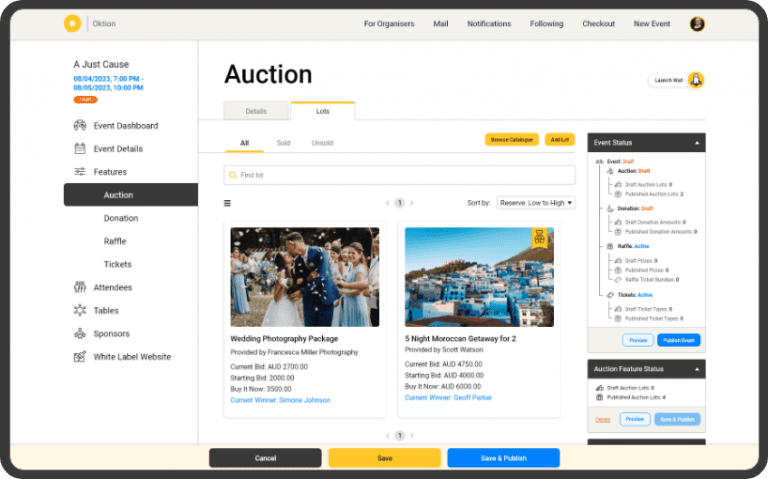
With Oktion’s silent auction feature, organisers can set up lots with images, starting bids, increments and reserves. Supporters can bid online, use automatic maximum bidding and receive notifications about bidding activity. For venue-based events, Oktion also offers a live auction projection option.
Create an event, add the auction feature, configure lots and dates, and publish the event and auction. See Oktion’s silent auction setup guide for screen-by-screen instructions.
Before launch, test bidding on a phone and check photos, terms, closing times and payments. Budget using the current Oktion fees.
Ready to organise your fundraiser? Start your school fundraiser with Oktion.
Step 6: Promote the auction beyond the P&C committee
Promote through the school newsletter, approved parent channels, P&C social accounts and participating donors.
A manageable timeline might look like this:
- One to two weeks before opening: Announce the fundraising goal and tease two or three interesting prizes.
- Launch day: Share the live auction link, the closing date and a short explanation of how bidding works.
- Midway through: Feature individual lots and thank participating local businesses.
- Final 24 hours: Remind supporters of the exact closing time and where to place bids.
Focus on the project, prize, deadline and action. For example: ‘Help fund new library resources for [School]. Our silent auction is open until [day, time]. Explore the donated prizes and place your bid at [link].’
For fetes, use a QR code linking to the auction. Respect school privacy permissions.
Step 7: Keep supporters engaged before bidding closes
Monitor bids. If a lot gets little interest, improve its description or photograph and feature it in a reminder. Do not change donor terms unexpectedly.
Spotlight different price points and ask donors to share the auction link.
Oktion’s automatic bidding and notifications help supporters follow lots. Send a clear final-day reminder without overwhelming families.
Step 8: Close the auction, organise payments and report results
Assign responsibility for payments and collection. After closing, check reserves and payment status, then give winners collection instructions.
Track each lot’s payment and collection status securely. Thank donors and ask permission before naming winners publicly.
Report gross auction proceeds, expenses and net funds raised separately. Also record the number of lots listed and sold, bids per lot where available, and which promotion channels generated interest. If the fundraiser falls short of its target, say how much was raised towards the goal rather than implying the goal was reached.
Debrief on popular prizes and what volunteers would change next year. Store donor information securely.
School silent auction planning checklist
Check these before launch:
- ☐ Confirm the school project, fundraising target and required approvals.
- ☐ Assign a coordinator and owners for prizes, auction setup, promotion and finance.
- ☐ Record donor permissions, expiry dates, terms and collection arrangements.
- ☐ Photograph lots and write clear, accurate descriptions.
- ☐ Set starting bids, increments, reserves and opening and closing times.
- ☐ Check the budget, including platform and transaction fees.
- ☐ Test the online bidding experience on a phone and publish the auction.
- ☐ Schedule launch, midpoint and final-day promotional messages.
- ☐ Plan winner communications, payments, collection and thank-you messages.
- ☐ Report gross proceeds, costs and net results to the school community.
Frequently asked questions about school silent auctions
How many auction items should a school have?
There is no fixed number. For a first-time committee, 15 to 30 well-presented lots may be easier to source and promote than dozens of weak listings.
How long should a school silent auction run?
Five to seven days is one possible starting point. Align the dates with school communications and any fete.
Can people bid without attending the school event?
Yes. Online bidders can participate without being at the venue.
Is a silent auction the same as a raffle?
No. The highest eligible bid wins an auction lot; raffles use chance-based draws and may have different rules. Check local requirements.
What does it cost to run a school auction on Oktion?
Check Oktion’s fees page and allow for relevant payment and fulfilment expenses.
Ready to start your school’s fundraiser?
Choose a fundraiser your volunteers can deliver: a clear goal, worthwhile prizes and simple bidding.
Oktion helps your P&C run an online auction or offer bidding alongside a school event. Start your school fundraiser, add your silent auction and publish it when your lots and communications are ready.
Categories : Auction Management,Organisers
Tags :
A school silent auction can turn donated prizes into practical support for students, while welcoming supporters who cannot attend a fete. Families can browse items and bid online, with the highest eligible bid winning when each lot closes.
Good planning makes the difference: a clear goal, appealing prizes, simple instructions and defined volunteer roles. For committees comparing P&C fundraising ideas, a school auction fundraiser can run online or alongside a fete. Here is how to get started.
Step 1: Set a fundraising goal and work backwards from it
First, agree on a specific project, such as playground shade, library books or sports equipment. Obtain school or P&C approvals before approaching donors.
Set a net fundraising target, then account for likely costs: platform or feature fees, transaction charges, printing, packaging and any purchased items. For example, a committee aiming to keep $6,000 after $600 in expenses needs approximately $6,600 in gross proceeds. With 30 auction lots, that works out to an average winning bid of $220 per lot. This is illustrative, not a forecast. Check whether it is realistic for your community.
Track the goal, expected bids, costs, confirmed donations and actual results in a spreadsheet.
Step 2: Put together a small P&C fundraising team
Keep the committee small, but give each task an owner:
- Coordinator: Confirms school approvals, decisions and deadlines.
- Prize lead: Contacts businesses and collects donation details.
- Auction lead: Photographs items, writes descriptions and checks bidding settings.
- Promotion lead: Prepares newsletter, social and event communications.
- Finance and fulfilment lead: Reconciles results and arranges prize collection.
If possible, start six to eight weeks ahead and confirm prizes two weeks before launch. Track donors, lot details, restrictions and collection status in one shared sheet.
Check local approval requirements. The NSW Department of Education, for example, publishes fundraising guidance for public schools.
Step 3: Source school silent auction prizes people want
Prioritise appealing items over sheer volume. Start with businesses familiar with the school and ask families for introductions.
Consider a mix of school silent auction ideas:
- Local experiences: A family restaurant voucher, swimming lessons, theatre tickets or a weekend activity.
- Practical favourites: Gardening services, a car detail, a family photo session or a grocery hamper.
- School-community experiences: Reserved concert seating or a special school experience, where approved by school leadership.
- Standout packages: A short getaway, sports memorabilia or several complementary vouchers bundled into one lot.
Ask for a specific item, such as a family brunch voucher, and explain its purpose:
Hello [Business Name], our P&C is running a silent auction to help fund [specific project]. Would you consider donating [suggested item or experience]? We would be pleased to acknowledge your support in our auction communications, with your approval. The auction runs from [date] to [date], and I can arrange collection. Thank you for considering it.
Record expiry dates, exclusions, delivery costs and donor permissions for photos and business names.
Step 4: Set starting bids, increments and auction dates
For every lot, set:
- Starting bid: The first amount someone can offer.
- Bid increment: The minimum increase required for a new bid.
- Reserve: A minimum sale price if one is necessary and permitted by the donor’s terms.
- Closing time: The exact day and time bidding finishes.
For example, a donated voucher with a stated value of $150 might open at $60 with $10 increments. Adjust settings to suit each prize and explain any reserve.
Consider a five to seven day online bidding window, promoted in advance. An evening close may suit parents better than school pick-up time. State the time zone.
Use clear photos and state what is included, restrictions and collection arrangements.
Step 5: Set up an online school silent auction with Oktion
Online bidding reaches supporters beyond the venue and reduces paper bid sheets.
With Oktion’s silent auction feature, organisers can set up lots with images, starting bids, increments and reserves. Supporters can bid online, use automatic maximum bidding and receive notifications about bidding activity. For venue-based events, Oktion also offers a live auction projection option.
Create an event, add the auction feature, configure lots and dates, and publish the event and auction. See Oktion’s silent auction setup guide for screen-by-screen instructions.
Before launch, test bidding on a phone and check photos, terms, closing times and payments. Budget using the current Oktion fees.
Ready to organise your fundraiser? Start your school fundraiser with Oktion.
Step 6: Promote the auction beyond the P&C committee
Promote through the school newsletter, approved parent channels, P&C social accounts and participating donors.
A manageable timeline might look like this:
- One to two weeks before opening: Announce the fundraising goal and tease two or three interesting prizes.
- Launch day: Share the live auction link, the closing date and a short explanation of how bidding works.
- Midway through: Feature individual lots and thank participating local businesses.
- Final 24 hours: Remind supporters of the exact closing time and where to place bids.
Focus on the project, prize, deadline and action. For example: ‘Help fund new library resources for [School]. Our silent auction is open until [day, time]. Explore the donated prizes and place your bid at [link].’
For fetes, use a QR code linking to the auction. Respect school privacy permissions.
Step 7: Keep supporters engaged before bidding closes
Monitor bids. If a lot gets little interest, improve its description or photograph and feature it in a reminder. Do not change donor terms unexpectedly.
Spotlight different price points and ask donors to share the auction link.
Oktion’s automatic bidding and notifications help supporters follow lots. Send a clear final-day reminder without overwhelming families.
Step 8: Close the auction, organise payments and report results
Assign responsibility for payments and collection. After closing, check reserves and payment status, then give winners collection instructions.
Track each lot’s payment and collection status securely. Thank donors and ask permission before naming winners publicly.
Report gross auction proceeds, expenses and net funds raised separately. Also record the number of lots listed and sold, bids per lot where available, and which promotion channels generated interest. If the fundraiser falls short of its target, say how much was raised towards the goal rather than implying the goal was reached.
Debrief on popular prizes and what volunteers would change next year. Store donor information securely.
School silent auction planning checklist
Check these before launch:
- ☐ Confirm the school project, fundraising target and required approvals.
- ☐ Assign a coordinator and owners for prizes, auction setup, promotion and finance.
- ☐ Record donor permissions, expiry dates, terms and collection arrangements.
- ☐ Photograph lots and write clear, accurate descriptions.
- ☐ Set starting bids, increments, reserves and opening and closing times.
- ☐ Check the budget, including platform and transaction fees.
- ☐ Test the online bidding experience on a phone and publish the auction.
- ☐ Schedule launch, midpoint and final-day promotional messages.
- ☐ Plan winner communications, payments, collection and thank-you messages.
- ☐ Report gross proceeds, costs and net results to the school community.
Frequently asked questions about school silent auctions
How many auction items should a school have?
There is no fixed number. For a first-time committee, 15 to 30 well-presented lots may be easier to source and promote than dozens of weak listings.
How long should a school silent auction run?
Five to seven days is one possible starting point. Align the dates with school communications and any fete.
Can people bid without attending the school event?
Yes. Online bidders can participate without being at the venue.
Is a silent auction the same as a raffle?
No. The highest eligible bid wins an auction lot; raffles use chance-based draws and may have different rules. Check local requirements.
What does it cost to run a school auction on Oktion?
Check Oktion’s fees page and allow for relevant payment and fulfilment expenses.
Ready to start your school’s fundraiser?
Choose a fundraiser your volunteers can deliver: a clear goal, worthwhile prizes and simple bidding.
Oktion helps your P&C run an online auction or offer bidding alongside a school event. Start your school fundraiser, add your silent auction and publish it when your lots and communications are ready.